





The Business Side of Content Creation: What I’ve Learned the Hard Way
I wrote a guide to ShopMy after receiving so many questions on Threads regarding the platform. However, I noticed that a lot of folks who had questions were also new to content creation, or at least to treating it less like a hobby and more like a business.
TL;DR
The Quick Version
Over 20 years of content creation I've learned a lot and here's the short version: own your platform, brand yourself consistently, treat it like a business from day one, and don't air your dirty laundry. Details and how-tos below…
While I am primarily a blogger, this advice works for most digital content creators. TikTokkers, Instagrammers, podcasters, Substackers, YouTubers, Facebook creators, and any combination of these and other platforms. If you make content on the internet and make money from it (or want to make money from it), I hope this advice proves helpful.
Why I am Sharing this Business Advice With You
There is no manual on how to be a digital content creator, and there couldn't be one, because we all run our brands differently, with different audiences and different goals. That being said, I have been a content creator for over two decades and have learned a lot of things the hard way. I like to say I went to the University of Google, because that is how I learned everything I know about running a successful content creation business.
Content creation runs on gatekeeping and smoke and mirrors. That creator with 500,000 followers may not be able to pay her rent this month, and the person who hasn't touched their Instagram in two years may be raking in seven figures. A lot of big creators have teams: managers and agents who secure opportunities for them, assistants who edit their videos and create their blog posts, interns who vacuum their carpet and clean the mirror for that perfect bedroom selfie of their OOTD or video of their GRWM. And a lot of small creators are making bank without all the pomp and circumstance.
Why I Am Qualified to Offer Creator Business Advice
Hi, I am Alison Gary, and I have been blogging at Wardrobe Oxygen since 2005. When Facebook became a thing, I made a Facebook page, and then a Facebook group. I dabbled in YouTube, but preferred to blog. I was on Snapchat back in the day, on Twitter until it became X, I am on Instagram, I was on Threads, then left, then came back. I never did TikTok (at least as a creator), I have a Substack, done a bit of UGC, but this site is my baby, my home.
I hit six figures from Wardrobe Oxygen for the first time in 2016. In 2017, I quit my day job to pursue content creation full-time and have never looked back. I am the sole breadwinner for my family, and have continued to find financial success through a pandemic, perimenopause, the passing of my mother, raising a teen, and never making a single TikTok.
What You Need as a Professional Content Creator
If you are earning money from the content you create, you are a professional. Folks are quick to dismiss this job, but that is because they don't understand it. We are a one-person company. We are the photographer, the copywriter, the model, the stylist, the graphic designer, the editor, the HR department, the office manager, the social media manager, business development, accounts payable, and accounts receivable. And usually it is us: our names, our faces, our lives, that is the product.
Be proud of what you do, and do it well. Respect yourself, your audience, and the brands that choose to work with you. Treat your business like a business from the get-go, whether you are making $500 or $500K and it will be oh-so worth it as you grow and succeed. Below are the things either I learned the hard way and think are most valuable when being an online content creator:
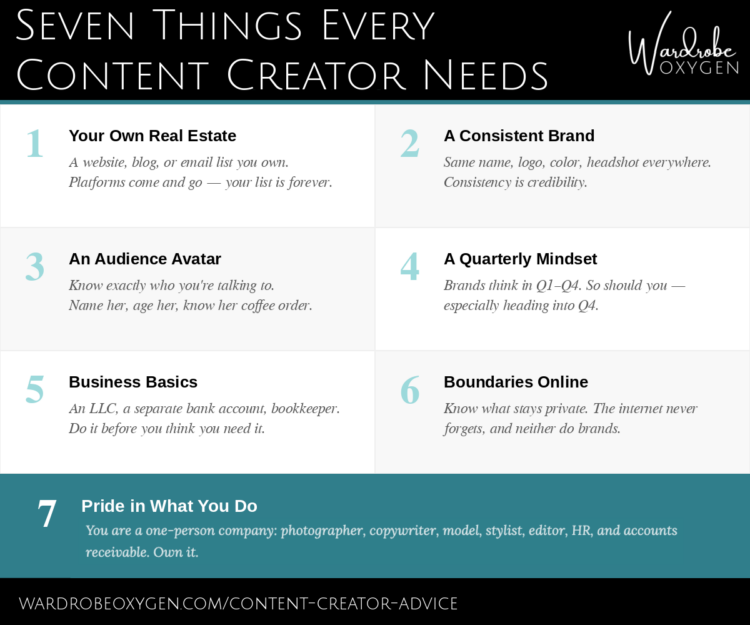
You Need Your Own Internet Real Estate
I've been around long enough to see platforms come and go. Who remembers TapInfluence? How about the more recent Shopstyle/Collective Voice? And let's not get into Tumblr, Periscope, Vine… You need to have your own real estate on the internet, or at least an email list that you use on the regular so you can build a community that will follow you wherever you go.
If you do not have a blog or website, I recommend starting a Substack or Patreon. It's free to use, has a social component so it's easier to gain subscribers, can be your newsletter tool while offering a permanent link to house your content.
- If you have never blogged or sent emails, start slow. Do a monthly recap: what did you do, what did you wear, where did you go, what did you buy, what did you read or watch or listen to. What were the top sellers in your community? Were you featured anywhere, share it with your audience! Show your personality, let people know who you are and why they may click with you. And of course, share links to all the places they can find you.
- As you get comfortable, consider going up to once weekly. Again it can be a recap-type piece, or it can be a theme.
- Once you have an email list, you can use it to promote sales and even get brands to sponsor it.
- Use ManyChat or LinkDM to get folks to subscribe to your email list. Add it to your link in bio, share stories occasionally mentioning it. If you don't spam folks with your emails and offer valuable content, you won't get a lot of unsubscribes.
Honestly, if you are on more than one platform it makes sense to have your own self-hosted website. No need for a blog like this site, but at least a splash page that has your photo, your bio, where to find you, and how to reach you. Squarespace and similar platforms make it pretty easy to do this yourself without having to hire help and there are plenty of YouTube tutorials out there.
You Need a Brand
To get respect, you need to look like you deserve it. And your business deserves a proper brand. Whether you go by your name or a catchy phrase, make it consistent across every single platform you are on and have it look similar, too. I'm telling you, it's game-changing when it comes to respect in emails, being interviewed for publications, and speaker opportunities. And honestly, fake it until you make it. In my experience, the things you need are:
- A headshot. This can even be a selfie, but it's one where you look like you (not filtered or AI you), has good lighting, an uncluttered background, and preferably you are wearing the color you associate with your business. Use this same exact headshot everywhere from LinkedIn to TikTok to ShopMy to the About page on your site.
- A logo. Whether it's the favicon on your website (that little graphic in the tab in your browser) or your mention in a conference program, it's helpful to have a logo. You can make this in Canva, or hire someone on Fiverr or Upwork to do it for very little. I have a few variations of my logo (a square one, a rectangle one, a long one), but if you're starting, one that can be on a square transparent background is all you need.
- A color. Whether it's your Linktree or the hyperlinks on your Substack, keep this a consistent color for brand recognition. Choose one that is easily found: pink, purple, orange, Kelly green, aqua… sometimes you can choose your color and sometimes you have to pick from an offering. If you have at least one color pretty common, you will have an easier time maintaining your brand across platforms.
- A banner. This is an extended version of the branding of your logo. Use it on LinkedIn, your Amazon storefront, YouTube, Facebook. Canva and other platforms know the dimensions needed for each platform, but like your headshot, it makes sense to have continuity across platforms for brand recognition.
- A custom email domain. This sounds hella complicated, but it's really not that hard and it gives you serious credibility. It should be either your name or the name of your business. Places like GoDaddy make it easy; I Googled how to do it and was able to set it up in less than an hour in Gmail. And a perk, you now own that URL so if/when you make a website, you're good to go!
In Corporate America, they have a term called an “elevator speech.” This is being able to tell someone what you do or what your business is within the time you are on an elevator together. That's about 30 seconds. You don't have to share your elevator speech with anyone — but craft one, write it down, and use it as your mantra. It helps you stay focused and reminds you that this is a business, not a hobby.
As your business grows, your branding likely will change. Heck, this site was originally called What Every Woman Needs In Her Wardrobe. Short and catchy, huh? My focus has changed, my colors have changed, my logo has changed, everything has changed. But what is constant is when it changes, it changes across the board. This detail shows you're a professional, and you will treat brands with the same attention to detail and consistency.
You Need an Audience Avatar
I have been asked to speak at a few college business schools about my experience as a content creator and I always share this bit of advice with them: create an avatar for your audience. It's hard to know what to say and do and create when you don't know who you are doing it for.
Of course, there is a range of people who consume your content, but envision a concept of who that is. How old are they? What is their name? What do they look like? Where do they live? What do they do in their freetime? Who did they vote for in the last election? What is their coffee order? This may sound glib, but narrowing it down like this really helps you see who your audience is and stay focused when you get brand opportunities, consider new platforms, and grow your business.
Just as with your brand, your avatar may change with time. I've gotten older, and my avatar has too. My avatar used to work in an office five days a week, and after the pandemic, she now works from home most of the time. These changes are natural, but should be slow adjustments over time so you don't lose the core audience who got you to where you are today.
You Need to See a Year in Quarters
Whether this is a side gig or your full-time job, influencing is a job and should be treated as such. Businesses, including the brands you partner with, live in the land of quarters. They look at revenue at the end of each, they plan for the different levels of traffic, the shopping trends, and the client/customer/audience needs depending on the time of the year.
For us creators, Q4 (October-December) is incredibly important. From back to school to Black Friday to holiday outfits and post-holiday sales, creators can make more in Q4 than they make in the other 75% of the year. Now you know why some influencers put their Christmas tree up in August!
No need to go that far, during the summer when traffic dips, take the time to start thinking how you want to handle the end of the year. Are you the kind of creator who makes gift guides? Offers family outfit suggestions for holiday card photos? Decor to decorate for the holidays? Halloween costumes or makeup? Start outlining what kind of content you think would be best for your audience, and honestly… start sharing it sooner than you think makes sense.
- Plot out your calendar. When are the holidays, the big sale dates, and when will you be out of town or overwhelmed with family or other activities.
- Pinterest and Google trend earlier than social media; you can start sharing such content up to two months before the actual event
- Nothing wrong with making videos and taking photos early when you have a quiet weekend. Just don't wear flannel and wool in front of a blooming azalea bush.
- Build your sections and collections in ShopMy and keep them hidden until ready to launch. Add products as they come available.
- Start making templates in Canva for gift guides, overlays, Stories. Then they're ready to drop in and go once you have the content.
I have learned come November 1st, it's holiday time. Use your newsletter to notify your community about the best sales, your gift guides on ShopMy and other platforms, your suggestions for holiday outfits, etc.
Once you get through your first Q4 seeing it like a business, you will have the tools and mindset for the other three quarters. There is a certain time for fitness and resolutions, for swimwear and sundresses, for graduation and wedding gifts, for overseas travel, for gardening, etc. Planning ahead will help you so much for your sanity and your income.
You Need to Treat Your Business Like a Business
If you're making more than a couple thou a year, you will have some serious taxes to deal with. And take it from me, someone who in the past 20 years has been audited, had payment plans with the IRS, and more than one occasion had the government come to me months later and say I owe even more… consider an accountant and use bookkeeping software.
At the start of 2024, I began using Peach Perfect Financials and it was the best investment I ever made for Wardrobe Oxygen. It is a bookkeeping and accounting company run by a CPA and former content creator who truly gets our job, our 3,957 1099s, our brand trips, our need for so many tripods.
We use Quickbooks online to manage my finances, I have completely separate bank and PayPal and Stripe accounts for my business, they tell me what I owe for quarterly taxes and how to submit it, they complete and file my taxes, they helped me go from a LegalZoom LLC to a proper S-corp, manage my payroll with Gusto, and offer business advice regarding retirement, expenses, and employees.
Not cheap, but when I find that I owe less than $100 to the government and am getting money back from the state after years of pain, it is such a valuable investment. If you're not there yet, Peach Perfect has some online products to get things organized on your own. TRUST ME, you want to do this sooner rather than later.
A NOTE FROM ALISON:
If you choose to use Peach Perfect, please let them know Wardrobe Oxygen sent you! I don't make a commission, but I want them to know how much I appreciate them!
If you're not at the CPA level yet, no matter how much money you make, I recommend these as a minimum when starting a business:
- Turn your business into at least an LLC. Sure this has all sorts of legal benefits, but it means you get a TIN and no longer have to give your social security number to all of these companies.
- Back in 2017, I did this with LegalZoom and had a mixed experience (it auto-signed me up for some crap I didn't need but ended up paying for). There are plenty of sites that will do it for you but also plenty of tutorials to do it yourself.
- Have a separate bank account for your business. I got a Novo account, which is completely online and fee-free. The app is easy to use, you can make “reserves” or buckets to save for taxes, etc. and it's super easy to transfer funds to my personal account.
- Unless you're savvy and/or have a lot of expenses, you can just use the check card for all your business expenses. If you use a credit card, again have one just for your business to keep things clean and separate.
- Take the time to switch all your ACH payments to the new account. I just committed a Sunday afternoon, went through all the previous year's 1099s to make sure I wasn't forgetting anyone.
- Any autopays for things like Canva, hosting, Meta verified, have them switched over to this account.
- Have a separate PayPal for your business. I ended up taking the PayPal account I had for everything under the sun and making it my business account, and then opening a new one for my personal shopping.
- If you pay contractors or VAs via Venmo, you can add a business account to your existing account for no cost. It will pay via your business account and it's no additional cost.
- Have a folder in your email to store receipts and invoices for the year. Also make a Google folder or some other online folder where you can save photos of any physical receipts for business expenses. You may never need them… but as someone who has been audited, I was glad I had this to back up my claims.
You Need to Not Air Out Your Dirty Laundry
My mom used to say that, “some folks like to air out their dirty laundry,” meaning they would share a little too much. In the time of social media and engagement from being real, she'd likely freak out at what we all share. I share a LOT; I share health issues, marriage issues, perimenopause side effects, and to my daughter's dismay there are many pictures of me on the internet in my underwear.
However, I have learned over the years that some things do not need to be shared. Here's the stuff I've learned to keep off the internet, the hard way:
- The front of your house or housing complex. Doesn't matter how small your audience, there are some creepy creepers out there.
- Your activities in real time. Unless a brand is paying you, wait until you've left the location to share. Again, I've experienced my share of weirdos, and I am a middle-aged mid-sized mom with a relatively small following.
- Your personal data. Labels on prescription pills. Barcodes on shipping labels. Your driver's license. Mail sitting on a table in the background. We've all seen enough TV shows with FBI and hackers to know someone can do a still, zoom in, clean up the resolution, and get what they need. So think before you film.
- Legal proceedings unless it's public. If you're in negotiations, if you're considering hiring a lawyer for an issue, if you're in mediation… keep it off the internet. It can affect your case, settlement, and more.
- An active issue with a brand, influencer platform, or business. Again, sharing it online can feel good and can get great engagement, but it can really affect the results and can get you blackballed.
- Details from brand campaigns, influencer platforms, ad networks, and affiliate platforms. This is usually in the T&C, but few read them. But if you share a screenshot of communication with a brand in ShopMy, share an email from a brand you're contracted to work with, tell folks how much you made from a project, or even your commission % with a retailer, it can get you booted from the program.
- Talking smack about a human in your life. Your ex, your old boss, your neighbor, that woman at church… assume it will get back to them. It will get back to them. Make it so general it can't be connected, or keep it off the internet.
- Sharing how you broke a law or did something clearly unethical. My friend, the internet never forgets. And it doesn't matter how minor or funny you think it is. You have no idea who you will be and what the world will be like in a few years. Keep that ish in your group text, if even that.
- Bitching about your audience. Nobody wants to hear you boo-hooing about lack of engagement, folks not giving you the feedback you expected, or the mean people in your comments. Once or twice, that can be humorous, relatable, and bring mad engagement. But if it becomes a habit, you're going to turn off more folks than you attract (including your original audience and brands).
I feel like I sound like a mom. I am a mom, but I am also someone who spent her adulthood online. I was in AOL chatrooms in college, message boards in my 20s and 30s, planned my wedding with The Knot, survived pregnancy with The Bump, had accounts on Friendster and MySpace.
I started my first blog in 2003 and one post I wrote on that “anonymous” blog got me denied a government clearance for my job when I applied two years later. I lost a lot of followers when I bitched and moaned more than once about being talked about on a snark site. And I have seen on sites like that, screenshots of blog posts I have since deleted and Tweets I sent back when it was still Twitter. And in the grand scheme of things, I am a nobody. Just think before you share, your future self will thank you.
I know I wrote a novel, but it's the novel I wish someone wrote for me when I started out as a content creator. When you start with the right tools and the right mindset, it can set you up for faster and greater success. And I wish you great success with your business!

Did you like what you just read?
Consider tapping here to buy me a coffee in thanks. The best gift you can give a content creator is the gift of sharing. Consider sharing this article on Facebook or Pinterest. Thank you so much for your support!




I’m not in this business but always find your posts like this interesting and informative. It’s a great resource for anyone who is in this business and a good reminder for others about all the work involved, especially behind the scenes.