






How Long Should Women’s Pants Be? A Complete Hemming Guide by Style
One of the most common questions I get from readers: how long should my pants actually be? Years ago, there was a cut-and-dry answer, but these days, even hemlines get caught up in fashion trends. However, there are some classic guidelines to follow if you’re looking for a traditional cut or how to hem your trousers for the office. Below, I share how to determine the proper pant length for women with a full update for 2026 incorporating the most popular pant styles, shoe trends, and size inclusion.
Quick Reference: Pant Hem Length by Style
| Pant Style | Ideal Hem Length |
|---|---|
| Classic & Menswear-inspired Trousers | ½” from floor with a slight “break” at front |
| Wide Leg & Flares | ¼” from floor with just a peek of toe |
| Bootcut | ¼”–½” from floor depending on shoe height |
| Skinny Jeans & Pants | Top of ankle — some pooling is fine |
| Straight Leg | Bottom of ankle; no break is needed |
| Ankle Pants | At or just above ankle bone: always show skin above shoe |
| Barrel Leg | Just above to bottom of ankle bone; the fuller the barrel the longer the pant can be |
Why Proper Pant Length Matters
Choosing the proper pant length will make you look polished, your clothing will look more expensive, your figure more balanced. Too long of trousers, and the effect is sloppy; too short and you can ruin the line of your look.
You should always get your pants hemmed while wearing the shoes you plan on wearing with them. This will get a better feel for how the pants actually hang on you and will ensure a proper length hem.
This is a big reason why I recommend keeping your shoes around two different heights – a flat height, and a heel or wedge height. This way, you can switch around shoes while your pants still hang correctly.
How to Determine Proper Pant Length for 2026
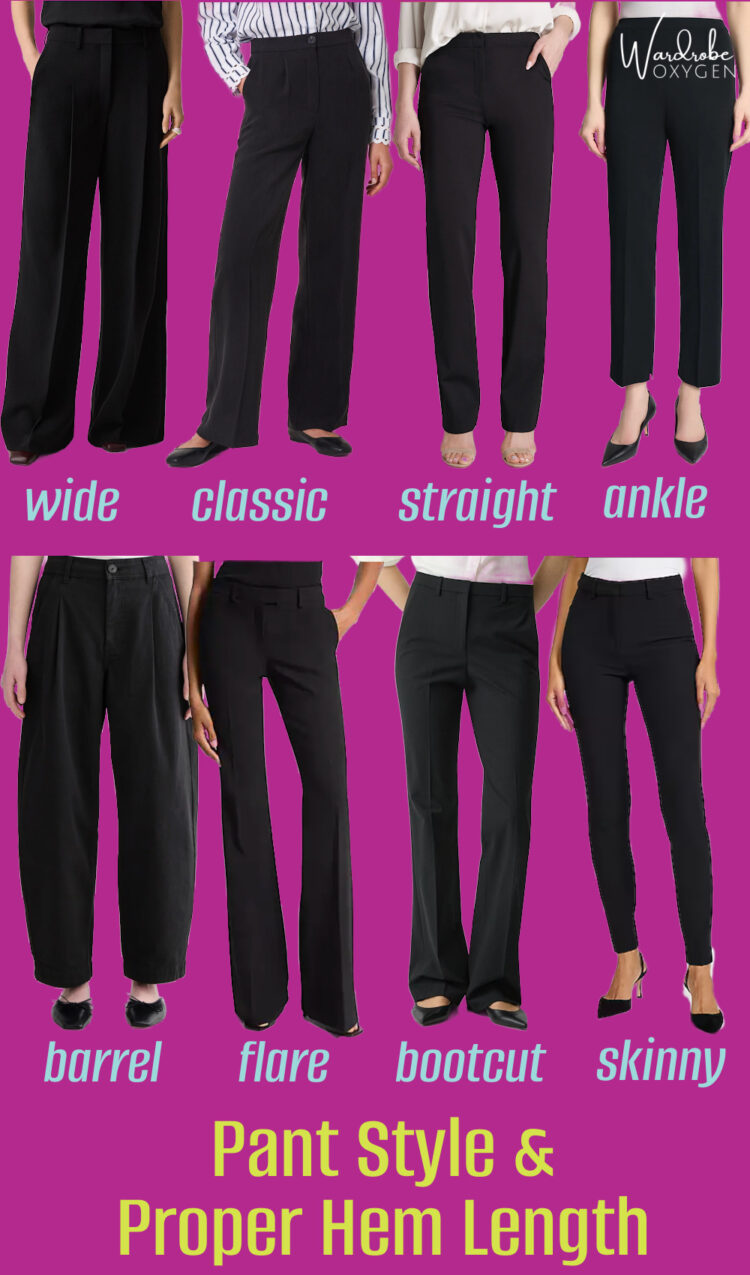
Below, I will be using a lot of terminology about pant cuts. The graphic above shares the six most popular cuts of pants for women, and the general length that is most accepted for each style. I hope this graphic helps you understand my descriptions below when offering tips on hemlength for women's pants and jeans.
STYLIST'S TIP:
Always hem pants while wearing the shoes you plan to pair with them.
Proper Hem Length for Classic and Menswear-inspired Trousers
When I state classic trousers, these are work pants that aren’t fitted, not overly wide of a leg, no flared bottom, or cropped style. A straight, slightly wide, faintly bootcut, or menswear-inspired pant, whether it is part of a suit or a pair of ponte knit you wear on the weekends the back of the trousers should be ½” off the floor.
This is enough to be sure you don’t step on them, there’s usually a bit of a “break” (when the drape has a bend near the hem), and they have great drape. This ½” guide works for heels and flat shoes.
When wearing pumps or flats, you want the pant long enough that the top of your foot is covered and only the shoe peeks out.
Proper Hem Length for Wide Leg Pants and Flares
Wide leg jeans and pants, and extreme flares look best with a longer length. For such pants, you almost want your shoe hidden; the back of the pants or jeans should be ¼” off the floor. This length will keep them from dragging but will give a modern, clean look. Only a peek of your toe should be showing.
If this feels too long, consider the type of shoes you are wearing with these wide pants. A full-length wide pant looks best with a shoe of substance. Switch out your comfy ballet flats for a trendy sneaker, a round-toe shoe with one with an elongated toebox. The proportions may feel a bit more comfortable.
Proper Hem Length for Bootcut Jeans and Trousers
A bootcut is between the classic and the wide-leg styles; you can go with ¼” to ½” from the floor. Again, shoe style is a big determinant; the length of a bootcut with flats can look like highwaters with pumps. If you wish to wear a bootcut pant with both flats and heels, style with a heeled boot that slips under the hem for a modern vibe.
If you know you need to hem a lot from a bootcut or flare jeans, I recommend going with petite or trying a different style, as you may end up losing or ruining the actual silhouette with the alterations.
Proper Hem Length for Skinny Jeans and Pants, Jeggings, and Leggings
Skinnies are the easiest to determine proper pant length for women. Skinnies should end at the top of the ankle, but if they gather or pool a bit it’s okay. Also, because they are a shorter style, they can work equally well with heels and flats.
Proper Hem Length for Straight Leg Jeans and Pants
Since straight-length pants won’t always fit over shoes and don’t “break” well when longer, they can be shorter than other styles of pants. I recommend having the hem hit the bottom of the ankle before your foot starts. However, if you desire a longer pant and the fabric works, you can go longer. Just don’t go too short; a straight pant can easily look like a too-long ankle pant or “highwaters” when too short.
Proper Hem Length for Ankle Pants
Every season, it seems that trendy ankle pants are a different length. Like skirt hem lengths, the best choice is to have the ankle pant at a length to highlight the slimmest part of your ankle. To show these are ankle pants and not too-short straight or skinny pants, you need to show some skin.
An ankle pant, whether it is slim or wide-leg, should end somewhere around the ankle bone; I find being short with thick legs I prefer near the bottom of the ankle bone, while someone with thin or long legs may like a shorter pant.
An ankle pant should never skim your shoe. No matter the style of footwear, there should be skin between them and your hem. Since this is a shorter pant and you’re not worrying about a “break,” you can wear the same length ankle pant with heels and flats. If you wear with boots, they should be tall enough to hide under the pant hem.
Proper Hem Length for Barrel Jeans and Pants
Barrel jeans are a trend that doesn't seem to be going anywhere any time soon. It's also a trend that can be kind of tricky when it comes to shoe pairing and hem length.
Barrel jeans and pants, in general, end anywhere from just above the ankle bone to just below it. It really is personal preference. Shorter lengths look good with sandals, clogs, and low-profile sneakers while longer options may be preferred for fall and winter as they work better with loafers and boots. A general guide is the fuller the leg, the longer the hem, but again it's personal preference.
Pant Hem Length Tips for Petite Women
As someone who is 5'3″, I have strong feelings about this.
The number one mistake petite women make with pants is skipping the tailor altogether. We tell ourselves the length is “close enough” — and then we wonder why our outfits never look quite right. The truth is, almost no off-the-rack pants fit a petite frame without some adjustment, and the hem is the single alteration that makes the biggest visual difference.
A few things I've learned the hard way:
- Buy petite when you can, but don't assume petite = correctly hemmed for you. Petite sizing is designed for women 5'4″ and under, but there's a wide range in there. I still often need to take an inch or two off petite pants, especially trousers and wide legs.
- Wide leg and flare pants are the trickiest. When you hem a wide leg pant significantly, you can lose the intended silhouette — the flare starts higher than designed, throwing off the proportions. If you're removing more than 2–3 inches, look for a petite-specific cut or a brand that offers short inseams in that style before buying.
- Ankle pants may not need hemming… but placement matters more. On a petite frame, where an ankle pant hits is everything. Too high and it looks like you outgrew them. Too low and the whole point is lost. Aim for the hem to land right at or just below your ankle bone, with visible skin above your shoe. On me, that's usually around 26–27 inches inseam.
- Straight leg pants are your friend. They're easier to hem without disrupting the silhouette, and they don't require you to commit to one heel height the way wide legs do.
- When shopping online, always check the inseam length in the product details and compare it to your own measurements before ordering. For reference, I typically need a 28–29″ inseam for flat shoes and 30″ for a low heel in most styles.
Common Questions Regarding Women's Pant Lengths


Did you like what you just read?
Consider tapping here to buy me a coffee in thanks. The best gift you can give a content creator is the gift of sharing. Consider sharing this article on Facebook, Threads, or saving on Pinterest. Thank you so much for your support!
Want to see more Wardrobe Oxygen in Google?

Great points, thank you. Could you add info on wide-leg crops? They seem to end at mid-calf, i.e., the widest part of your lower leg, but there’s great variation. As a tall person, I can’t decide if I’m better off shortening them, letting out the hem if possible, or even fraying the hem. I’ve seen them worn with heels, but I prefer them with flat sandals. Thoughts?
I didn’t add wide-leg crops because of this very reason. I think it’s a personal preference. As someone with large calves, shin, and ankles I like them longer but I have seen them an inch or two below the knee and look great and on others they look wonky. With flats I’d think a bit longer may look better; I fully support a released hem and love that it’s now fashionable to wear released hems!
You inspired me. Spending the morning picking out stitches to hem up two pair of slacks. Also taking a pair in at the waist, because they actually fell down one day. Procrastination overcome. Thank you.
Can you also comment on maxi dress lengths? I’m so confused as to what’s best with my petite, curvy bod, and the thought of dress dragging on the filthy ground sleeves me out! Thanks!!
I don’t understand exactly where you mean on skinnies. Top of the ankle is where? How is that different from ankle pants, which I thought were shorter, yet you say they can go down anywhere along the ankle bone?
Do you ever hem pants on an angle so there’s a slight break in the front but not too short in the back? I do this frequently. It seems like all my pants really need this. Classic cut. Not overly wide. 1 1/2 heel.
Binder clips work well for commuting hems…
This is one of my questions, too! I also wanted to ask (or did I?) about how to hem – do you use needle and thread or that sticky stuff (less permanent?) or what? Esp important if the pants shrink in the second/third washing – etc. I am SO AFRAID to hem pants!! How wide of a hem is ok? I like to cut as little as possible in case of errors, shrinking, etc.
Always launder a pair of pants before altering them. They shouldn’t keep shrinking after one wash, if so you should be washing in a different manner (no dryer, gentle cycle or dry clean). I take my pants to my dry cleaner to hem because when I have tried on my own they have never been even no matter how many times I measure. Also, having someone else do it you’ll get a more accurate length with your shoes because you’re standing upright. Too wide or thick of a hem and you can end up affecting the drape of the pant and the hem will be obvious. More than 2″ can look wonky; lighter-weight fabrics can sometimes handle 3″. You don’t want to just cut and hem; some fabrics you’ll want bias tape. Heavier fabrics you can foldover and hem, others you’ll want to serge the edge to prevent fraying. A hem seam is an invisible one too, which is tough to do on your own. I’ve used Stitch Witchery before and it’s not bad for basic suiting trousers, but won’t hold with heavier fabrics like ponte, and will be stiff/obvious on lighter weight fabrics. Depending on whether the pants are stretchy or lined, getting my cleaner to hem pants starts around $12 which really is a good deal to get a custom fit!
Thanks! Yeah, I figured a wide hem was probably not advised. Maybe I will just take to my tailor/dry cleaner….
I have trouble getting Stitch Witchery to adhere properly without burning my fingers.
Three heights for me, so I stay perpetually confused – flats, low boot, and heels.
This is a great guide, thanks!
To the commuter question: I wear a pair of dress socks with my flats, fold the socks them over at the ankle, fold the bottom of my pants under and catch the hem of the pants in the fold of the socks at the back only. It stops the backs of pants from getting stepped on, but is subtle and doesn’t leave marks or creases in the pants. It won’t really work if your pants are hemmed for 6 inch heels….but more modest lengths will work.
What a great hack, thank you Mallory!